IVF Clinic Closing Down? A Step-by-Step Guide to Protecting Your Embryos


TL;DR: A fertility clinic closure, sudden bankruptcy, or ownership change can leave your embryos, sperm, or eggs in limbo with very little warning. It's frightening, but it's also manageable — the two things that matter most are speed and getting your samples moved by people who know exactly how to keep them safe in transit. This guide walks through what to do in the first 48 hours, what your legal position actually looks like, and how a supervised relocation is carried out properly under time pressure.
📞 If your clinic has announced a closure and you need to move your samples now, call us directly:
Line - Telegram - WeChat - WhatsApp: +44 7585 610211
Phone: +44 20 8150 0059
Why This Happens
Fertility clinics close for the same reasons any medical business closes — bankruptcy, a lost funding contract, an ownership sale, a regulatory investigation, or a legal dispute that makes continued operation untenable.
This isn't rare: clinic closures, sudden practice changes, and disputes over stored embryos have made headlines repeatedly in recent years, often leaving hundreds of patients with very little notice and even less clarity about what happens next. Sometimes a receiver or court-appointed administrator steps in to safeguard samples during the process. Sometimes patients are simply asked, on short notice, to say where they'd like their material sent. Either way, the emotional weight of it is real, and so is the practical urgency.
If you're reading this because your clinic has just announced a closure, take a breath — the situation is stressful, but it is very rarely a situation where samples are lost outright. The far more common failure point is delay: patients unsure of what to do, waiting on unclear communication, while a transfer window quietly narrows.
The First 48 Hours: What to Do Immediately
Get the closure notice in writing, if you haven't already, including the exact date the facility will stop maintaining storage and any deadline for you to nominate a destination.
Ask directly: who is currently responsible for the tanks? In a bankruptcy or receivership, this may not be the clinic's original staff — get the name and direct contact of whoever now has legal custody of storage.
Confirm your samples' exact identification details — patient ID numbers, straw or vial labelling, and current tank/location reference. You want this in writing before any transfer, not verified for the first time mid-move.
Choose a receiving clinic or storage facility now, even if it's a temporary holding location rather than your final destination. You cannot arrange transport without somewhere confirmed to send it to.
Contact a specialist reproductive-material courier immediately — not a general medical courier, and not a same-day parcel service. This is the step most patients don't know is available to them, and it's usually the fastest way to convert "we have 10 days to move everything" into a same-week, supervised relocation.
Do not sign a blanket disposal or abandonment waiver under pressure, even if it's presented as a routine part of the closure paperwork, without understanding exactly what it releases you from and what it doesn't. If you're unsure, this is worth a few hours with a lawyer before signing anything.
Understanding Your Legal Position
This is general information, not legal advice — the details vary significantly by country, by state, and by the specific terms of your original storage agreement, and you should get advice specific to your situation. But broadly:
Your original storage agreement is the starting point. It typically defines who owns the samples, what happens on non-payment, and what the facility's obligations are if it ceases operating — read it, even if it's years old.
A bankruptcy filing changes the process, not your ownership. Bankruptcy proceedings can pause related lawsuits and slow communication significantly, but they don't erase your legal claim to your own stored material — they do, however, make the process of getting clear answers much slower, which is exactly why acting early on transport matters.
A receiver or court-appointed administrator's first job is usually to safeguard samples, not to make disposition decisions for you — but their priority is legal compliance, not speed, so patients who wait for the receivership process to "handle it" for them are often waiting longer than necessary.
You generally retain the right to direct where your own samples go, even during a closure, though the exact mechanism for exercising that right (a form, a court filing, a simple written request) depends on the circumstances.
How a Clinic-Closure Relocation Actually Works
Moving embryos, sperm, or eggs out of a closing facility isn't fundamentally different from any other cryogenic transport — but the timeline pressure changes what "getting it right" requires:
Verification against your original documentation. Before anything moves, the samples being collected are checked against your patient ID and storage records — this step doesn't get skipped just because the clock is running.
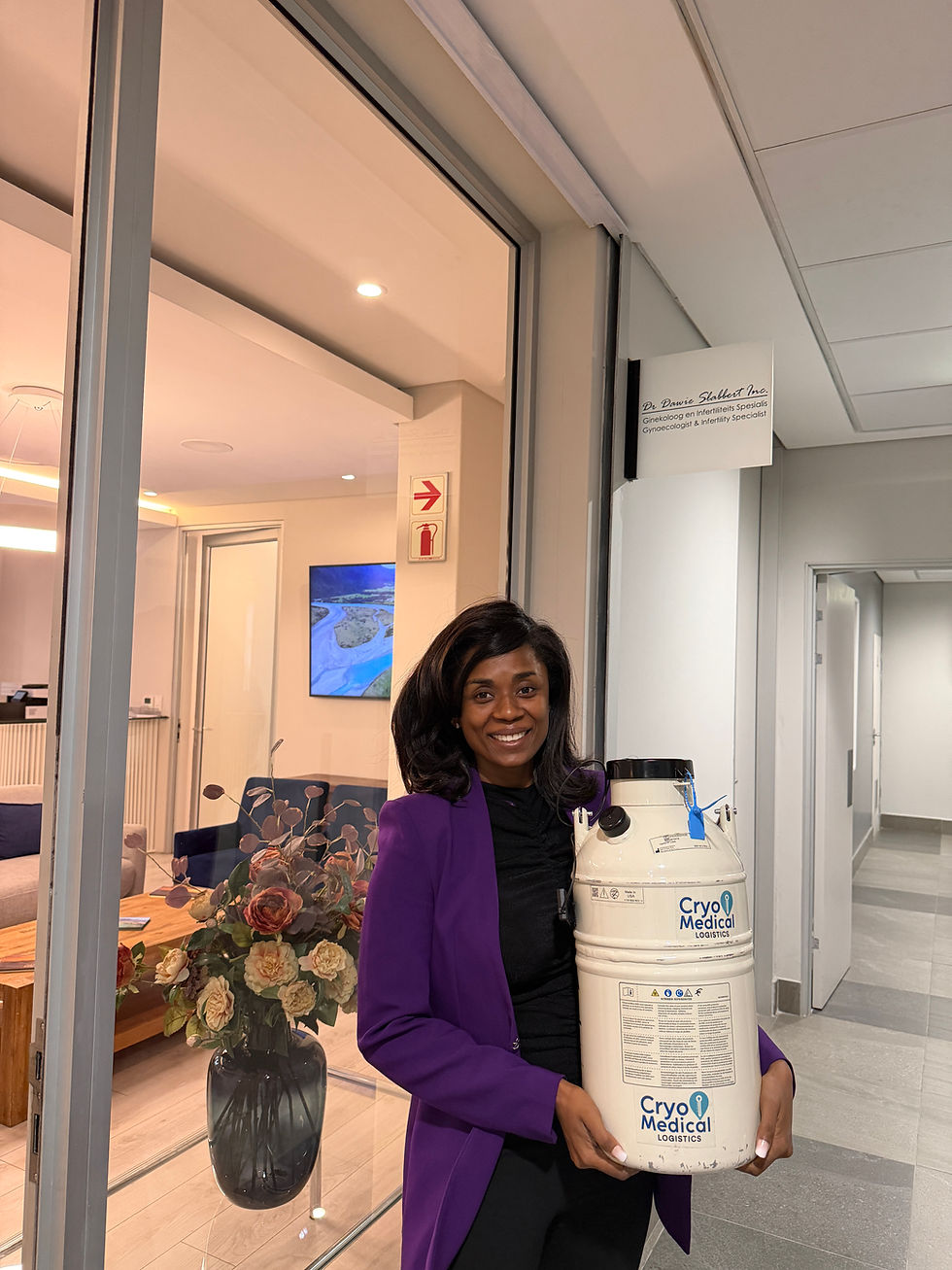
Transfer into a validated, pre-charged cryogenic dry shipper maintained at approximately −196°C, with the same temperature-stability standards as any planned relocation.
Supervised hand-carry to the receiving facility — never checked as cargo, never left unattended, and never routed through an X-ray or CT scanner at any checkpoint along the way.
A witnessed, documented handover at both ends, closing a full chain-of-custody record — which matters even more in a closure scenario, where the sending facility's own record-keeping may already be under strain.
The single biggest risk in a closure scenario isn't the physical transport itself — it's patients trying to arrange it themselves, under time pressure, without knowing the correct protocol for temperature validation, security screening, or documentation, because nobody told them a specialist option existed until it was almost too late.
Protecting Yourself Before This Happens
You can't predict a clinic closure, but you can reduce how exposed you are to one:
Re-read your storage agreement periodically, not just at signing — note the exact terms for non-payment, facility closure, and your rights to relocate on demand.
Keep your own copy of every identification detail — patient ID, sample labelling, exact tank/location reference — rather than relying on the clinic to have it readily available in an emergency.
Know in advance who you'd call if you ever needed an emergency relocation, rather than researching options for the first time while already under pressure.
Ask your clinic directly what their closure contingency plan is. A clinic with a real answer to this question is a meaningfully different risk profile than one that's never been asked.
Why We Lead on Emergency Embryo Relocation
We are ISO 9001:2015 compliant and carry FCA-regulated insurance across every shipment we handle in 80+ countries — but the credential that matters most in a closure scenario is speed without cutting corners. Every courier we deploy follows the same temperature-validation, Do Not X-Ray, and chain-of-custody standard whether the shipment was planned three months ago or three days ago. We've coordinated relocations under genuine time pressure, and the process doesn't change under pressure — only the timeline does.
ISO 9001:2015 compliant applied to every transport, planned or urgent
FCA-regulated insurance on every shipment
Strict Do Not X-Ray protocol, with trained hand-inspection requests at every checkpoint
Continuous temperature monitoring, giving a verifiable record even on a compressed timeline
Dual-witness, documented handover, which matters even more when the sending facility's own records may be in flux
Frequently Asked Questions
How quickly can embryos actually be moved out of a closing clinic? It depends on documentation readiness and how quickly a receiving facility is confirmed, but supervised relocations can often be arranged within days once those two pieces are in place — the bottleneck is almost always paperwork and decision-making time, not the physical transport itself.
Can a clinic legally refuse to let me move my own embryos? Generally no, though the exact process for exercising that right varies by jurisdiction and by the specifics of a bankruptcy or receivership process. This is a question worth a direct conversation with a lawyer if your clinic is pushing back.
What if I don't have a receiving clinic lined up yet? Contact a specialist courier as soon as possible anyway — many can advise on temporary storage options while you finalise your longer-term destination, rather than waiting until every detail is settled to start the process.
Is it safe to move embryos on a compressed, urgent timeline? Yes, provided the same cryogenic and chain-of-custody standards are followed as any planned transport. Urgency changes the schedule, not the protocol.
What if the clinic can't confirm my sample details clearly during a closure? This is exactly why keeping your own copy of your identification details matters. If there's ever ambiguity, insist on written confirmation matching your own records before any transfer takes place.
If Your Clinic Has Closed or Is Closing, Don't Wait
The fastest way to turn a frightening situation into a manageable one is to get your samples moving before the window narrows further. We handle exactly this, with the same rigour whether we're given three months' notice or three days.
📞 Get in touch with our team today:
Line - Telegram - WeChat - WhatsApp: +44 7585 610211
Phone: +44 20 8150 0059
This guide is provided for general informational purposes and does not constitute legal advice. Laws governing embryo ownership, storage agreements, and facility closures vary significantly by country and jurisdiction. Speak with a qualified lawyer about your specific situation, and with your clinic or receiving facility about your samples directly.



Comments